
How Many Sets and Reps Should a Beginner Do?
If you're new to strength training, sets and reps can make workouts feel more complicated than they need to be. Should you do 3 sets of 10? Five sets of 5? Twenty reps? And how do you know when to add weight?
For most beginners, you don't need a perfect formula. You need a simple starting point that gives you enough practice to learn the movements, get stronger, and recover well enough to keep training. This post will help you understand where to start, how hard each set should feel, and when to change either the reps or the weight.
How many sets and reps should a beginner do?
Most beginners can start with 2-3 working sets of about 8-12 reps for many strength exercises. That gives you enough practice to learn the movement while still using a weight that can be challenging. Some exercises work better with fewer or more reps, so treat 2-3 sets of 8-12 as a starting framework, not a rule you have to follow forever.
The weight matters too. You want a weight that lets you complete the planned reps with good control while still feeling like you could have done another 2-3 solid reps if you needed to.
What are sets and reps?
A rep is one complete repetition of an exercise. If you squat down and stand back up once, that's one rep.
A set is a group of reps performed together. If your workout says 3 sets of 10 goblet squats, that means you perform 10 reps, rest, then repeat that two more times. That gives you 30 total reps, broken into three manageable sets.
You'll also see the term working set. That's a set performed at the weight you're actually using for the exercise, as opposed to a lighter practice or warm-up set you may do first. When we talk about doing 2-3 sets in this article, we're talking about working sets.
How many sets should a beginner do?
For most beginners, 2-3 working sets per exercise is plenty. You don't need five or six sets of every movement just because more work sounds better.
Early on, the goal is to:
Learn the movement
Practice good technique
Use an appropriate weight
Build strength
Get enough practice to improve
Recover well enough to come back and train again
One working set can still be useful, especially if you're brand new, returning after a long break, or easing into a movement. But 2-3 sets gives you more opportunities to practice the exercise and challenge the muscles without making the workout unnecessarily long.
More experienced lifters may eventually do more. Beginners usually don't need to start there.
How many reps should a beginner do?
For many strength exercises, 8-12 reps is a simple place to start. It gives you enough repetitions to practice the movement without requiring the heavier weights that usually come with very low-rep sets.
But 8-12 isn't a magic range. Depending on the exercise, you might also see:
5-8 reps on a heavier strength exercise
8-12 reps on many squats, presses, rows, and similar movements
10-15 reps on accessory exercises
12-20 reps on smaller movements where lighter weights often make more sense
The number of reps and the amount of weight should work together. If you're doing 6 reps, you'll generally use more weight than you would for 15 reps of the same exercise.
Is 3 sets of 10 good for beginners?
Yes. Three sets of 10 can be a perfectly good setup for many beginner exercises. It's popular because it's easy to understand: you perform 10 controlled reps, rest, and repeat.
But there isn't anything special about the number 10. Three sets of 8, two sets of 12, or another reasonable combination can also work well depending on the exercise and what you're trying to accomplish.
The more important question is whether the set is challenging enough without causing your form to fall apart.
How hard should each set feel?
Each set should feel challenging in the last few reps, but it doesn't need to feel like an all-out effort. For most beginner strength work, a good goal is to finish the set feeling like you could have done about 2-3 more good reps.
That usually means:
The first few reps feel manageable
The last few require noticeably more effort
You can still control the movement
Your technique stays consistent
You aren't grinding through sloppy reps just to finish
If you finish 10 reps and feel like you easily could have done another 10, the weight is probably too light for that goal. If you're supposed to do 10 but your technique starts breaking down at rep 6, the weight is probably too heavy.
If you're not sure how to choose the weight itself, read How Much Weight Should a Beginner Start With?.
Should beginners train to failure?
Usually, no. Training to failure means continuing a set until you can't complete another good rep.
Beginners don't need to do that to make progress. Stopping a little before failure lets you practice better reps, manage fatigue, and usually makes it easier to recover between workouts.
That's especially useful when you're still learning the movements. A set should feel challenging, but challenging doesn't have to mean completely exhausting yourself.
Should every exercise use the same sets and reps?
No. Different exercises can make sense with different rep targets.
For example, a heavier squat or deadlift variation may use fewer reps because each rep is more demanding. A smaller exercise like a lateral raise may use more reps because you're working with a much lighter weight.
A simple beginner workout might include:
Goblet squat: 3 sets of 8
Chest press: 3 sets of 10
Row: 3 sets of 10
Romanian deadlift: 2 sets of 10
Lateral raise: 2 sets of 12-15
Core exercise: 2-3 sets
You don't need every exercise to match. The sets and reps should fit the movement and the goal of that exercise.
When should you add reps or increase the weight?
A simple approach is to work toward the top of your rep range first, then add a small amount of weight when those reps feel controlled and appropriately challenging.
For example, if the goal is 8-10 reps and you can complete all 10 with good control while still having a little left in the tank, you may be ready for a small increase next time. If the weight still feels challenging and you're working toward 10 reps, stay where you are.
This approach is sometimes called double progression because you're gradually progressing the reps first and the weight second. You don't need to increase the weight every workout.
Progress can also mean:
Doing one more rep
Using slightly better technique
Moving with better control
Using a little more weight
Having the same weight feel easier than it used to
Those are all signs that your training is moving forward.
What this looks like at bStrong
At bStrong in Bellevue and Redmond, members don't have to decide their own sets, reps, exercises, and weights every time they walk into the gym. The workout is already planned.
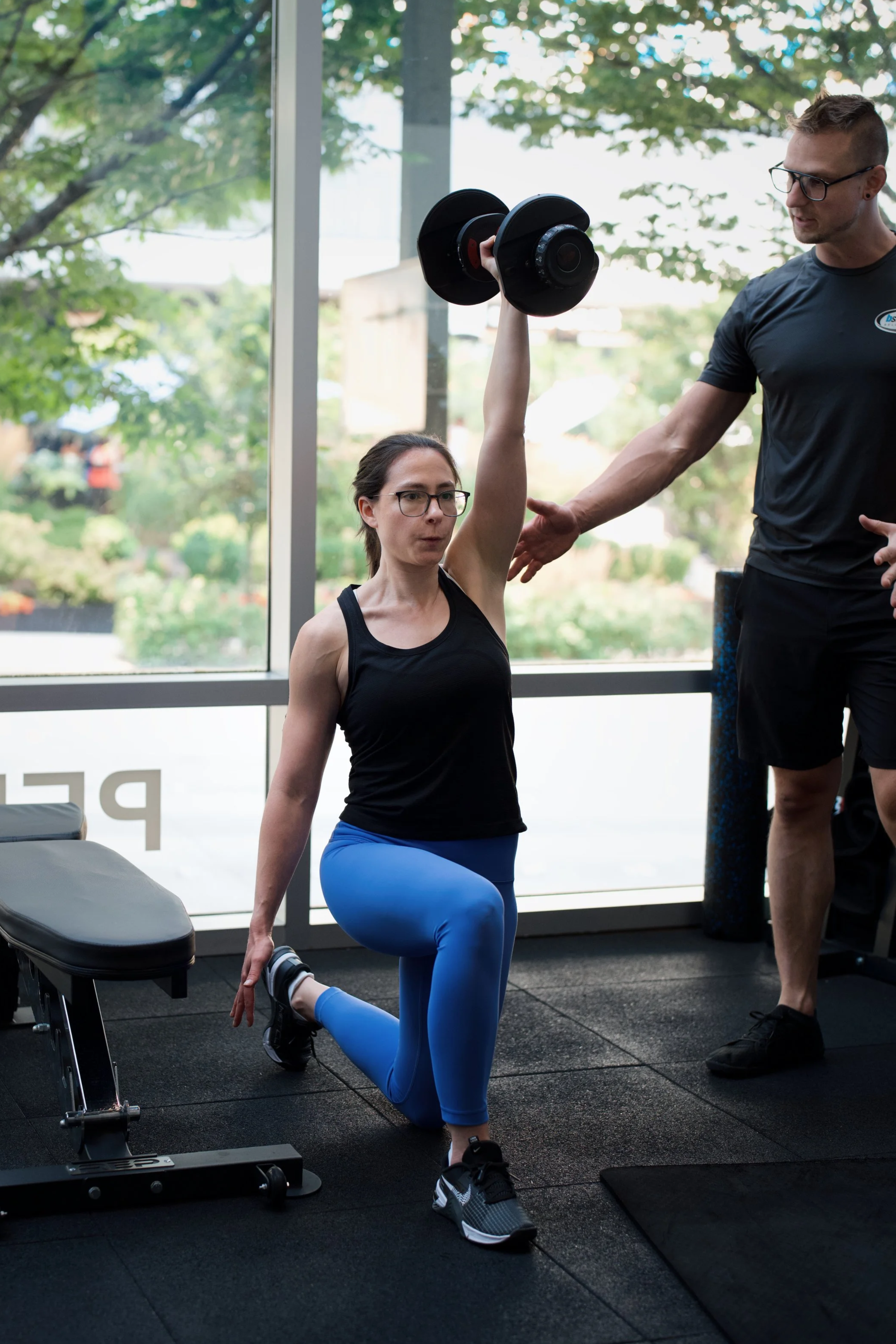
You'll see the exercises and rep targets on the TV when you come in. Early on, your coach helps you choose smart starting weights and learn what different rep ranges should feel like.
We also track your working weights and reps. When an exercise comes back, your coach can give you a clear starting target based on what you did last time and the reps you're doing that day.
If today's workout calls for fewer reps, you may be able to use a little more weight. If it calls for more reps, the target may be lighter.
Especially in the first few workouts, we'll often use the first working set as useful information. If the reps look smooth and you clearly have plenty left, we may move the weight up. If your form starts changing earlier than expected, we'll pull the weight back.
And if you're sore, tired, tight, or something doesn't feel right, we adjust.
That's one of the biggest benefits of Small Group Personal Training: you don't need to understand all the programming behind the scenes. You can focus on doing the workout well while your coach helps make the decisions.
How can a beginner apply this?
If you're building your own strength workout, keep it simple:
Choose 4-6 basic exercises.
Do 2-3 working sets of each.
Use roughly 8-12 reps for many of the exercises.
Finish most sets with about 2-3 good reps left.
Add a rep or a small amount of weight when the current workload starts feeling easier.
You can make the details more specific as you gain experience.
If you're not sure how often to train, read How Many Days a Week Should Beginners Strength Train?.
For a broader guide to getting started, read our Beginner Strength Blueprint.
Want help taking the guesswork out of your workouts?
If you want to get stronger but don't want to figure out sets, reps, exercises, and weights on your own, our 3-week trial is a good place to start.
You'll get:
An intro consultation
An optional Intro / Ramp-Up workout
6 coached Small Group Personal Training workouts
An InBody scan
Practical nutrition resources
Coaching and adjustments throughout the trial
Your workouts will already be planned, and your coach will help you choose appropriate weights and adjust as you go.
Frequently asked questionS
How long should beginners rest between sets?
For many beginner exercises, about 60-90 seconds is a reasonable place to start. Heavier or more demanding movements like squats and deadlifts may need closer to 2-3 minutes so you're ready to perform another good set.
If your reps are getting sloppy because you're rushing, rest longer. You don't need to start the next set just because the clock says so.
How long should a beginner strength workout take?
Many beginner strength workouts can fit into about 45-60 minutes, including a warm-up. The exact time depends on how many exercises you're doing, how much rest you need, and how the workout is structured.
More time isn't automatically better. A focused workout that covers the basics can accomplish plenty without taking over your day.
What if I can't finish all the reps?
Don't force sloppy reps just to hit the number. If you can't complete the planned reps with good control, stop the set and adjust.
That might mean using a little less weight, doing fewer reps, or simply giving yourself more rest before the next set. Missing a rep occasionally isn't a problem. If it keeps happening, that's useful information that the current weight or rep target may need to change.