
Your Back Rounds When You Deadlift? Try These Two Fixes

If your back rounds when you deadlift - or even when you pick something up off the floor - you're not alone.
Most people assume it means they're doing something wrong or that they have a bad back.
Here's what's actually happening: for most people, rounding shows up more when the setup is off or tension disappears before the pull. Both are fixable. This post gives you two simple fixes you can apply in your next session.
What does back rounding in a deadlift actually mean?
A small amount of movement in the spine during a deadlift is normal and not automatically a problem. What we're paying attention to is rounding that affects your ability to hold position - where your back changes shape as the weight gets heavier, the rep feels like a yank off the floor instead of a controlled stand, or it feels mostly like low-back strain, especially if it also feels loose or harder to control as the weight goes up. In most cases this is a setup and tension issue, not a structural problem. The fix is better shape and more tension before you pull - not avoiding the movement.
Why back rounding happens
For most people, rounding tends to show up when one or more of these is present:
Starting too far from the weight
Approaching the bar like a squat rather than a hinge - knees forward, hips too low
Hips starting low and shooting up before the weight moves
Not bracing or engaging the lats before pulling
The weight or range of motion being more than your current hinge can support
Instead of thinking "perfect form," think: better shape plus more tension before the pull.
For the broader picture on safe lifting fundamentals, read our How to Lift Safely guide.
Fix 1 - Clean up your setup shape
The most common cause of rounding is a squat-style setup: knees shoot forward, shins tilt, and the back rounds to reach the weight. The deadlift is a hinge, not a squat.
The setup sequence
Stand with the weight directly over the middle of your foot - not over your toes
Feet roughly hip-width for conventional, or slightly wider if that suits your build
Get tight at the top first - core, lats, glutes - before you hinge down
Soften your knees, then push your hips back rather than dropping straight down
Keep your shins as close to vertical as you can - a small forward angle is fine, but significant knee travel forward is where the problem starts
Let your arms hang vertically - outside your legs for conventional, inside for a sumo-style stance
Quick check once you're in position
When your setup is right you should feel:
Hamstring tension - a pull in the back of the legs
Weight balanced through your whole foot, not just the toes
Hips and shoulders rising together when you start the pull - hips don't shoot up first
If your knees are significantly forward and your hips are very low, your setup is too squat-like. Push your hips back more before you start.
Fix 2 - Wedge the bar and turn your lats on before you pull
This is the fix that eliminates rounding most quickly. Most people pull first and try to get tight second. We want the opposite: get tight first, then pull.
The wedge and lats sequence
Grab the bar with straight arms and crush your grip
"Break the bar" - try to bend it into a horseshoe shape. This engages your lats
Squeeze your armpits tight - this is the lat engagement cue
Take a 360 breath - expand all around your torso, not just your chest - and brace like you're about to take a light punch to the midsection
Pull the slack out of the bar and feel the whole system get tight before the weight leaves the ground
Push the floor away and stand tall
You should feel connected throughout - lats, core, legs, glutes all working together before anything moves. Deadlifts aren't about yanking the weight up. They're about holding your shape and pushing your hips forward while staying tight.
If rounding still happens - how to regress the movement
If you can't hold your shape with the current setup, adding more reps or more weight won't fix it. Rounding that persists is almost always one of three things: too heavy, too much range of motion, or not enough tension before the pull.
Two regressions we use regularly:
Raised deadlift (bar on blocks or plates): Same movement pattern with less range. A shorter range of motion makes it easier to maintain position while you build the shape and tension habits.
Kettlebell deadlift: Easier to find the hinge naturally and keeps shins more vertical for most people. A great starting point before moving to a barbell.
If you feel it mostly in the lower back, two things usually help: more deliberate glute engagement at the top of each rep (quads tight, glutes tight, ribs down), and a better brace (full 360 breath before each rep, not just a shallow chest breath). Some lower back engagement during a hinge is normal - the signal worth paying attention to is when the rep feels loose, yanked, or progressively harder to control as the weight increases.
If you're concerned your form isn't solid enough to start, read our form and confidence post.
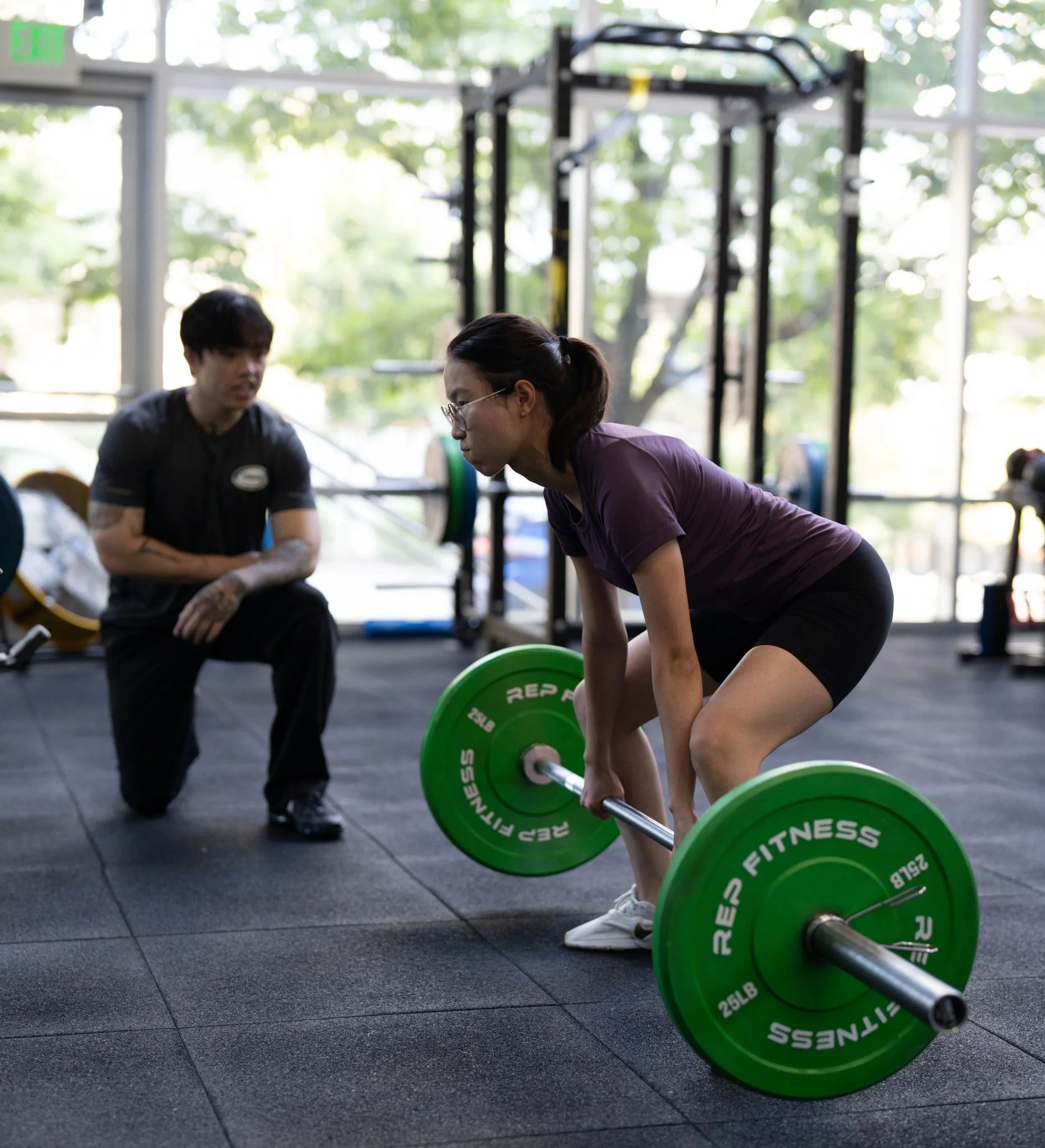
What this looks like at bStrong
At bStrong in Bellevue and Redmond, we coach the hinge constantly because it carries directly into real life - picking up kids, lifting a suitcase, grabbing a heavy box from a low shelf.
Most people who are nervous about deadlifts do much better once the movement is coached, scaled, and matched to where they're starting. Here's how the first few sessions typically go:
We choose the best hinge variation for where you're starting - often a kettlebell deadlift first
We coach setup shape: shins more vertical, hips back, weight over midfoot
We coach tension: lats on, 360 brace, pull slack out before the lift
If someone gets squatty or rounds, we adjust stance, range, and load immediately
When a movement comes back, your coach gives you a clear starting target based on what you did last time - no guessing week to week
The hinge is one of the most transferable movements we teach. Getting it right early pays off for years.
How to practice this in your next session
Optional warm-up drill: Stand with your back against a wall, then step forward about six inches. Hinge back until your hips touch the wall. This teaches the hip-back pattern before you add weight - a useful 30-second check.
Then with weight:
Start lighter than you think. You're practicing shape and tension, not testing a max.
Do 3 slow setup reps: get tight at the top, hinge back, shins mostly vertical.
Do 3 "wedge" reps: break the bar, squeeze armpits, 360 breath and brace, pull slack out, then lift.
Stop the set when the shape breaks. Clean reps only.
Leave 1-2 reps in the tank.
Frequently asked questions
Is back rounding always dangerous?
Not automatically - a small amount of movement in the spine during a deadlift is normal. What matters is control. If rounding increases as the load rises, you can't hold tension, or the rep gets more aggressive and less controlled as you go heavier, that's where it becomes worth addressing. Scaling back, cleaning up the setup, and improving your brace are the right responses - not avoiding the movement entirely.
Should I deadlift from the floor if I'm new?
Not necessarily. Many people start with a kettlebell deadlift or a raised pull - same movement pattern, less range of motion - so they can build the hinge shape and tension habits before pulling from the floor. If you can maintain a solid position from the floor, go for it. If not, reduce the range and build from there.
What's the fastest way to improve deadlift form?
Fix your setup shape (shins more vertical, hips back, weight over midfoot) and practice the wedge sequence: break the bar, squeeze your armpits, take a full 360 breath and brace, pull the slack out before the weight leaves the ground. Practice with a light kettlebell first, then apply the same cues to a barbell.
How heavy should I go when I'm learning the hinge?
Lighter than you think. The hinge pattern requires tension and coordination that needs to be practiced before it's loaded heavily. A weight that feels easy while you focus on setup is the right starting point. Add load gradually once the shape holds consistently across multiple reps and sets.
Can I deadlift if I have lower back issues?
Often yes, with the right approach and appropriate scaling. Let your coach know about any history at your consultation call - we adjust the variation, range, and load accordingly. If you have an acute injury or a diagnosed condition, check with a physical therapist before loading the movement. A properly coached, scaled hinge is usually very different from what caused the original issue.
What's the difference between a deadlift and a kettlebell deadlift?
The movement pattern is the same - a hip hinge where you push your hips back, maintain tension, and stand tall. The kettlebell version is generally easier to learn because the weight sits between your feet rather than in front of them, making it easier to keep shins vertical and find the hinge naturally. It's a great starting point before progressing to a barbell.
If you want coached strength training where someone can help you clean up your hinge in real time - our 3-week trial is a great place to start.
A consultation call, an Intro / Ramp Up session, 6 coached small group personal training workouts, an InBody scan, and practical nutrition resources - all for $99 at our Bellevue and Redmond locations.