
Small Group vs. 1-on-1 vs. Large Group - What's Best for Beginners in Bellevue and Redmond?

You've probably tried something before. A gym membership you stopped using. A class that felt overwhelming. A program you followed for two weeks and then life got in the way.
The problem usually isn't willpower. It's structure. Most people pick a workout based on intensity or price - not on whether it actually gives them what they need to stay consistent.
Here's an honest comparison of all three formats from coaches who work with beginners every day.
If you're brand new to lifting and want a simple starting point, read our Beginner Strength Blueprint first.
Which training format is best for beginners?
The short answer:
1-on-1 training is best if you need fully individualized attention or have significant injuries
Large group classes are best if you already know how to lift and just want a workout
Small Group Personal Training is the best option for most beginners and people getting back into fitness
The biggest factor isn't the workout - it's having coaching, structure, and accountability
The best option is the one you can stick with 2-3 times per week consistently
Why the training format you choose actually matters
Most beginners need three things to succeed:
A plan so you're not guessing what to do
A coach to make sure you're doing it safely
Accountability so you don't fall off after a few weeks
The right training format provides all three. The wrong one leaves gaps - and those gaps are usually where people fall off.
If staying consistent has been your biggest challenge, our Consistency System breaks down how to build a routine that actually sticks.
What most people get wrong when choosing a training option
A few patterns come up consistently.
They choose based on intensity instead of consistency. The hardest workout isn't the best workout. The best workout is the one you show up to reliably, week after week, for months.
They assume group classes come with coaching. A coach leading a room of 20 people is managing the class - they're not coaching you specifically. Those are different things.
They think they need the "best" option instead of the most sustainable one. 1-on-1 training is excellent. It's also $100-150 per session. If that price creates financial stress or leads to skipping sessions, it's not the best option for you - regardless of quality.
They underestimate how much structure matters. Having a program that tells you exactly what to do, with a coach who tracks your weights and notices when something's off, removes the mental load that causes most people to quit.
They overestimate how much they'll figure out on their own. Most people who join a big box gym with good intentions and no program are gone within 90 days. Not because they're not motivated - because they have no structure.
Most people don't fail because they picked the wrong workout. They fail because they picked the wrong structure.
What is 1-on-1 personal training and who is it best for?
1-on-1 is you and a coach, working through a fully customized program every session.
What works well:
Maximum personal attention every session
Ideal for significant injury histories or complex individual needs
Fully built around your pace and goals
Very safe and controlled
What's harder:
Typically $100-150 per session in Bellevue and Redmond
Scheduling can be restrictive
Most beginners don't actually need this level of customization to get great results
If your budget allows it and you have circumstances that genuinely require individualized programming, it's an excellent option. For most beginners who want real coaching without the price of private training, our Small Group Personal Training is typically the better first step.
What is large group fitness and who is it best for?
Large group fitness is the Orangetheory, F45, CrossFit-style experience - big energy, lots of people, everyone doing the same workout.
What works well:
Fun, high-energy environment
More affordable
Motivating if you already feel comfortable in a gym setting
What's harder:
Individual feedback is limited - coaches manage the room, not each person
Easy to get lost in the shuffle
Technique often takes a backseat to intensity
Workouts move fast with limited time for corrections
Big classes work well for people who already know how to lift and want intensity and variety. For someone learning from scratch, the limited individual attention creates real gaps in safety and technique.
What is small group personal training and why does it work for beginners?
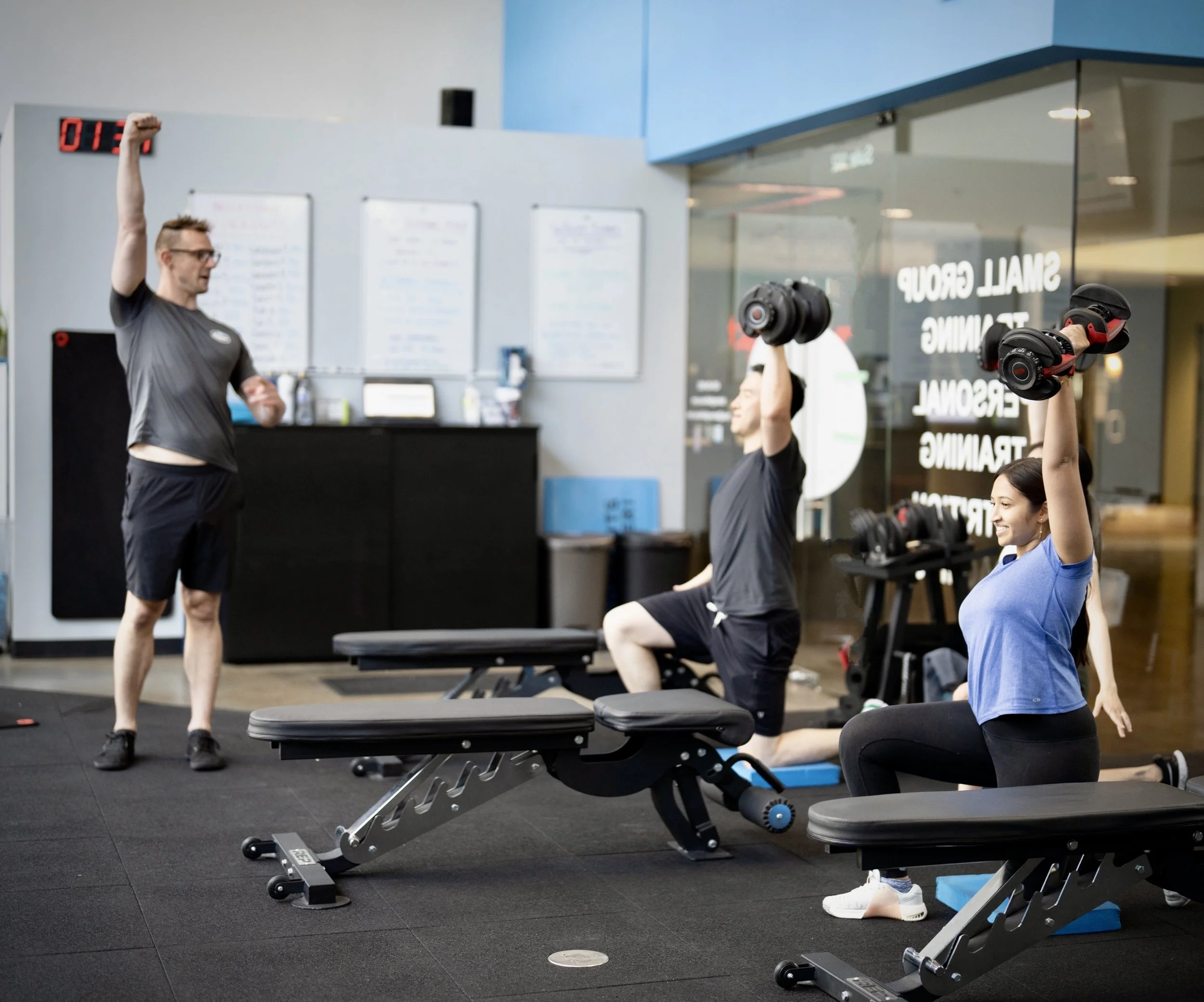
Small group personal training sits between the two - you train with 2-6 people, with a coach running a structured strength program that progresses week by week.
What most people notice right away:
A coach helping with form, weights, and technique throughout
A clear plan each day - no guessing
Movements scaled to your level
Coaching attention without feeling singled out
Group energy without the chaos of a large class
A fraction of the cost of 1-on-1 training
For someone starting from scratch or returning after time off, this combination is hard to beat.
How does small group training work at bStrong specifically?
At bStrong our sessions follow a structured strength program built around the fundamental movement patterns - squat, hinge, push, pull, and core stability. Everyone in the group follows the same session outline. Within that framework, coaches individualize what matters most for each person:
Scaling movements up or down based on strength and experience
Adjusting range of motion for mobility limitations
Modifying for injuries or joint issues
Helping you find the right starting weights
Tracking your weights every session so there's no guessing
The session structure is shared. The experience feels personal - because the coaching is.
How do all three formats compare?
Here's an honest side-by-side.
| Feature | 1-on-1 Training | Small Group PT | Large Group |
|---|---|---|---|
| Coaching attention | Maximum - fully individual | High - individual within group | Limited - group-managed |
| Cost per session | $100–150+ | $30–50 (at 2–3x/week) | $15–30 |
| Program structure | Fully customized | Structured, progressive | Varies, often no progression |
| Beginner-friendliness | High | High | Low |
| Injury risk | Low | Low | Medium to high |
| Accountability | High | High | Low |
| Community feel | Low | Medium | High |
| Best for | Complex needs, high budget | Most beginners and returners | Experienced lifters, cardio focus |
Which training format should you choose?
If you're unsure, use this as your default:
Beginner → Small Group Personal Training or 1-on-1
Returning after a break → Small Group Personal Training
Significant injury history or complex needs → 1-on-1
Already experienced, want intensity and variety → Large Group
Small group personal training is the right starting point for most people because it gives you coaching, structure, and accountability without requiring a large budget or committing to a program that's more complex than you need right now.
From coaching thousands of sessions: most beginners get the fastest results in a small group setting with real coaching and a clear plan.
For more on what strength training over time looks like - especially for adults 40 and up - read our Strength After 40 guide.
What does a small group session at bStrong actually feel like?
You walk in and your workout is on the screen - your name, the exercises, the target weights based on what you did last week. No guessing, no wandering around figuring out what to do.
The session starts with a warm-up, moves through a strength block with one or two main lifts and accessory work, and finishes with a short conditioning piece. Your coach demos the movements before anyone starts, helps you set starting weights, and checks in with every person throughout.
Most people feel noticeably stronger within 3-4 weeks. Meaningful changes in strength and body composition typically show up within 8-12 weeks of consistent training.
Frequently asked questions
Will I slow everyone else down if I'm a beginner?
No. Everyone works at their own level with their own equipment and weights. The session is structured so each person works independently within the group. We also offer an Intro Ramp-Up session for beginners before joining regular workouts.
Do I need experience before starting?
No. Most members start as complete beginners or after a long break. Your coach teaches the movements, helps you find starting weights, and adjusts everything to your current level. That's what the coaching is for.
Is small group training like CrossFit?
No. Sessions focus on strength, form, and controlled progressions. There's a short conditioning finisher at the end but it's not all-out intensity. The emphasis is on building strength safely over time. Read our CrossFit vs. bStrong comparison for a full breakdown.
What if I have an injury?
Tell us on your consultation call. We modify movements for injuries regularly - it's a normal part of how we coach. For significant injuries, we'd encourage you to consult your doctor or physical therapist as well. We work alongside medical providers frequently.
How does the pricing compare?
1-on-1 personal training in Bellevue and Redmond typically runs $100-150 per session. bStrong small group memberships range from $189 to $429 per month depending on frequency - 1x, 2x, or 3x per week. At 2-3 sessions per week you're typically paying $30-50 per session for individual coaching in a group of 2-6. See our full pricing page for current rates.
Where are bStrong locations?
We have locations in downtown Bellevue and downtown Redmond.
If you're still not sure, the easiest way to figure this out is to try it.
Our 3-week trial is $99 and includes a consultation call, an Intro Ramp-Up session, 6 coached small group personal training workouts, and an InBody scan. No long-term commitment. Locations in Bellevue and Redmond.
We’d love to guide you through your first steps toward getting stronger, feeling better, and actually enjoying training again.