
Bodyweight vs. Weights: Which Is Better for Strength Training?
If you're new to strength training, this question comes up fast.
Should I stick with bodyweight exercises? Or do I need to use weights?
A lot of people worry about choosing the wrong one - "what if I get hurt?" or "what if I'm not strong enough to use weights yet?" That hesitation is what keeps people stuck before they even start.
The good news is you don't need to pick a side.
Is bodyweight training or weight training better?
Neither is universally better. They do different things. Bodyweight exercises help you learn movement patterns and build coordination - a useful starting point for most beginners. Weights allow you to keep increasing the challenge gradually over time as you get stronger, which is what produces long-term results. For most people, the best approach uses both. The real key isn't the tool - it's progression. Consistently increasing the challenge over weeks and months is what builds strength, regardless of what's providing the resistance.
What bodyweight training does well
Bodyweight exercises - squats, pushups, lunges, planks, TRX rows - use your own body as resistance. They're useful because they teach you how to move before you add load. Learning to squat with good control before you put a barbell on your back is genuinely valuable. They also improve balance and coordination, engage stabilizing muscles, and build core strength in a functional way.
They're accessible, require no equipment, and are a reasonable starting point for most beginners - particularly people who haven't trained in a while or who are nervous about getting started.
For learning movement quality, bodyweight is often the right place to begin.
Where bodyweight training runs into limits
Bodyweight works well early on. But over time, continuing to get stronger becomes harder.
As you get stronger, some movements become too easy to produce a meaningful training effect. Others jump dramatically in difficulty with no good intermediate option - going from a regular pushup to an archer pushup, for example, is a large step with nothing useful in between. And resistance is difficult to adjust precisely - you can't add 5 pounds to a pushup.
That's where many people plateau with bodyweight-only training. Not because bodyweight exercises are bad, but because without a reliable way to keep increasing the challenge, progress slows or stops.
What weights add
Weights - dumbbells, kettlebells, barbells, resistance bands, cable machines - are tools that let you adjust resistance precisely and increase it gradually over time.
What that means in practice:
You can add 5 pounds to a squat when the current weight gets manageable
You can track exactly what you lifted last week and aim to do slightly more this week
You can scale difficulty up or down in small increments based on how you feel that day
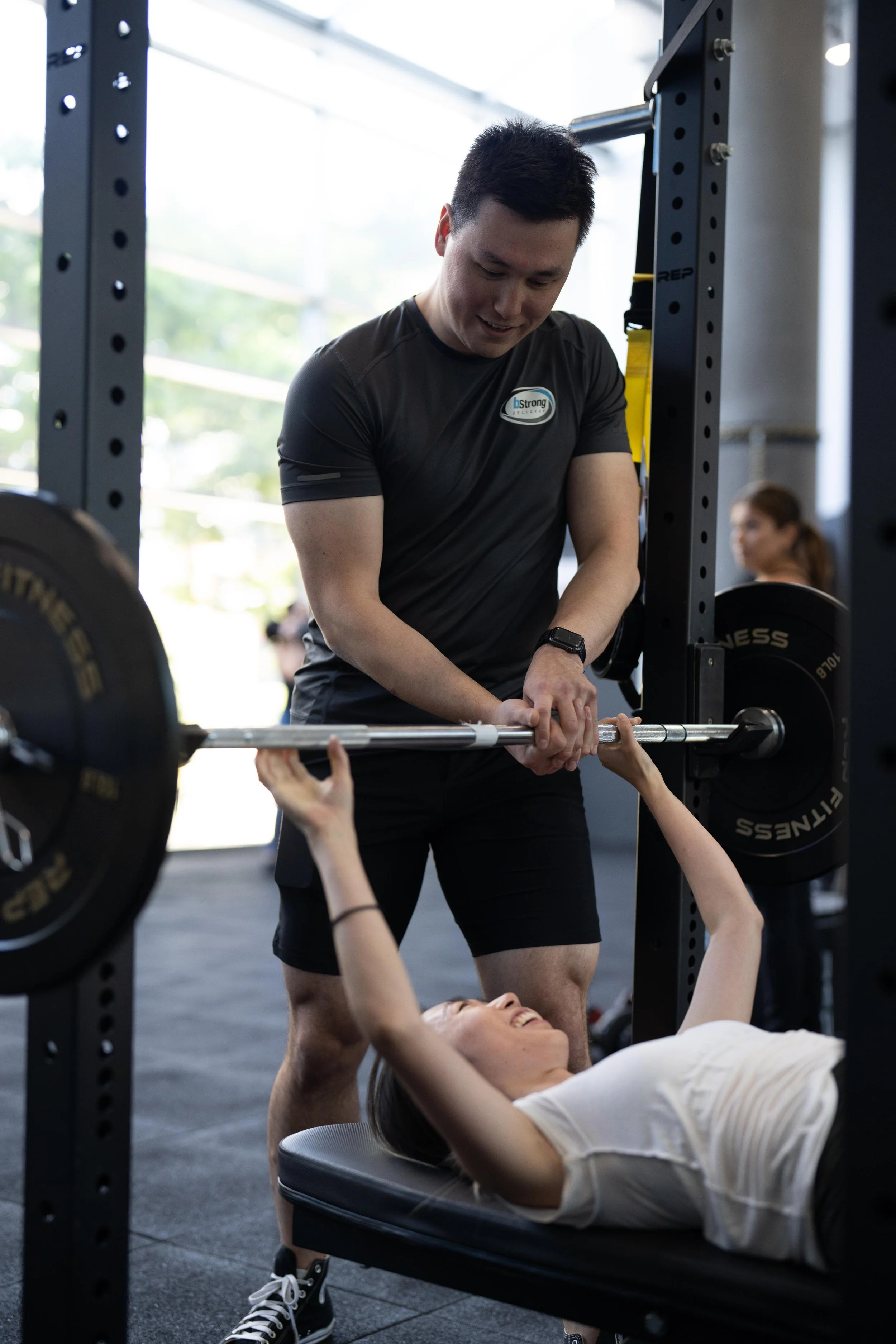
What weights don't mean: lifting heavy from day one, pushing to exhaustion, or doing advanced movements before you're ready. A beginner with good coaching using light weights is almost always safer and more productive than someone attempting difficult bodyweight progressions on their own.
Light weights with proper technique and gradual progression are the foundation of how most people make their best long-term gains.
Are weights safe for beginners?
Yes - when introduced properly. Most injuries from strength training come from doing too much too quickly, using poor technique, or training without structure or guidance. Not from the weights themselves.
A well-structured beginner program starts with manageable weights, prioritizes movement quality before adding load, and increases the challenge gradually. With that approach, weight training is not only safe for beginners - it's one of the most effective and joint-friendly forms of exercise available.
You don't need to be strong to start using weights. You get strong by using them correctly over time. For more on how to lift safely from the start, read our How to Lift Safely guide.
What most people should actually do
Start with movements you can do with control - whether that's bodyweight or light weights - and progress gradually from there.
In practice that often looks like:
Beginning with bodyweight versions of key movements (goblet squat, glute bridge, pushup) to build coordination and confidence
Adding light weights as movements start to feel controlled and repeatable
Increasing resistance gradually week over week as you get stronger
Both tools are used throughout - bodyweight for warm-up movements, mobility, and core work; weights for the main strength work where progressive overload is the goal. They're not competing approaches. They're part of the same program.
For a full breakdown of what that first 12 weeks looks like, read our beginner strength blueprint.
What this looks like at bStrong
At bStrong in Bellevue and Redmond, we don't treat bodyweight and weights as separate options. We use both throughout every session - based on what's right for the movement, the member, and where they are in their training.
Here's how the transition typically works for a new member:
The Intro Ramp-Up session introduces key movements - squat, press, hinge, row - at a controlled intensity with light weight or bodyweight, depending on the movement and the person
In the first few weeks, coaches help each member find starting weights that are manageable and safe for each movement pattern
As movements become familiar, weights increase gradually session to session
If something doesn't feel right, the coach adjusts - lighter weight, reduced range of motion, or a different variation
Most people who were nervous about using weights at all find that within a few sessions, they're more comfortable with it than they expected. The structure takes the guesswork out of it.
Frequently asked questions
Do I need to start with only bodyweight exercises?
Not necessarily. Many beginners use light weights from day one when guided properly - the weight is just low enough to allow good form while still providing a training stimulus. Bodyweight is a good starting point for learning movement patterns, but it's not a requirement before touching weights.
Will using weights make me bulky?
For most people, no. Building significant muscle mass requires very specific, sustained effort - high training volume, substantial calorie surplus, and typically years of consistent work. For most adults training 2-3 times per week with a balanced diet, the result is a stronger, leaner body - not dramatic size changes. This concern comes up most often for women, for whom hormonal factors make large muscle gain considerably harder than most people assume.
What if I've never lifted weights before?
That's completely normal - most people who join bStrong start with little or no lifting experience. The program is designed for exactly that starting point. The Intro Ramp-Up session exists specifically to build familiarity with movements before jumping into regular training.
Can I get strong with just bodyweight training?
Yes, especially early on. But long-term strength development typically benefits from added resistance. As your body adapts to bodyweight movements, you need a way to keep increasing the challenge - and weights provide that in a way that's hard to replicate with bodyweight alone.
How do I know when to add more weight?
A useful rule: when the last 2-3 reps of a set feel manageable with good form - not easy, but controlled - it's usually time to increase the weight slightly at the next session. If form breaks down before you finish the set, you're probably going too heavy. Your coach tracks this for you and gives you a starting target each session based on what you did last time.
Is strength training with weights different from going to a regular gym?
The equipment overlap - dumbbells, barbells, kettlebells - is similar. The difference at a coached facility like bStrong is that someone is watching your form, adjusting your weights, and progressing your program session to session. At a regular gym you're mostly on your own, which works well for experienced lifters and is a common source of stalled progress and injury for beginners.
If you've been stuck trying to figure out what you "should" be doing - bodyweight, weights, machines, classes - that's normal. Most people don't need the perfect method. They need a simple plan and someone to guide them through it.
Our 3-week trial is that place. A consultation call, an Intro / Ramp Up session, 6 coached small group personal training workouts, an InBody scan, and practical nutrition resources - all for $99 at our Bellevue and Redmond locations.