
Breaking the Sit-All-Day Cycle: How Strength Training Benefits Desk Workers
You sit down at 8am. You get up at noon to grab coffee. You sit back down. You get up at 6pm to go home.
If that sounds familiar, your body already knows the consequences. Tight hips. Stiff lower back. Rounded shoulders. That dull ache between your shoulder blades by 2pm.
Stretching helps a little. A standing desk helps a little. But neither fixes the underlying problem - the muscles that are supposed to hold you upright have gotten weak from not being used. That's what strength training addresses.
Does strength training help desk workers?
Yes - and it's one of the most targeted solutions available for the specific problems that come from sitting all day.
The short answer:
Sitting all day weakens key muscles and creates imbalances that cause pain and poor posture
Strength training directly reverses those effects by building the muscles sitting underuses
2-3 sessions per week is enough for most people to see meaningful results
You don't need to train daily - you need to train consistently
If you sit all day, strength training isn't optional. It's the most direct way to fix the problem.
If you’re in Bellevue or Redmond:
If you sit most of the day and your back, hips, posture, or energy are paying for it, this is exactly the kind of problem we help people work on at bStrong. Start with our $99 three-week trial.
What does sitting all day actually do to your body?
Most people underestimate this. Here's what's actually happening.
Your glutes stop firing. When you sit for hours your glutes - the largest muscles in your body - switch off. Over time they weaken and stop activating properly even when you stand. Weak glutes shift load to your lower back, which isn't built to handle it alone.
Your hip flexors shorten. Held in a shortened position while sitting, your hip flexors tighten and stay tight - pulling your pelvis forward and driving lower back pain.
Your upper back rounds. Leaning toward a screen stretches and weakens the muscles between your shoulder blades while the chest tightens to match. That's the rounded-shoulder posture that becomes harder to correct over time.
Your energy drops. Poor circulation from sitting, combined with the strain of holding yourself upright against weakened muscles, is genuinely fatiguing. The afternoon slump most desk workers feel is largely physical, not just mental.
Why do most desk workers struggle to fix this?
A few patterns come up consistently.
They stretch instead of strengthen. Stretching tight muscles provides temporary relief but doesn't fix the underlying weakness. Your hip flexors are tight because your glutes are weak. Your upper back rounds because your rowing muscles are weak. Stretching the symptoms without strengthening the cause means the problem keeps coming back.
They pick the wrong exercise. Running and cycling don't fix the specific imbalances sitting creates. HIIT classes are intense but not targeted at the glutes, rows, and core stability work desk workers actually need. Structured strength training with compound movements is the most direct fix.
They think they don't have time. Two to three 50-minute sessions per week is enough. Most people overestimate how much time is required and never start.
How does strength training fix what sitting breaks?
Each major problem from sitting has a direct strength training solution.
Posture and rounded shoulders
Rows, face pulls, and rear delt work strengthen the muscles between your shoulder blades that get stretched and weakened from screen time. When these muscles are strong they pull your shoulders back naturally. Deadlifts and Romanian deadlifts reinforce the posterior chain and teach your body to hinge properly rather than round.
Lower back pain
Weak glutes and tight hip flexors combined are the primary driver of lower back pain in desk workers. Deadlifts, hip hinges, glute bridges, and single-leg work strengthen the glutes and teach them to fire properly again. When your glutes do their job, your lower back stops compensating. Most people see meaningful improvement within 6-8 weeks. For more on how strength training supports injury prevention and recovery, read our injury prevention guide.
Tight hips and reduced mobility
Squats, lunges, and single-leg work move your hips through a full range of motion under load - improving mobility more effectively than passive stretching alone. Strengthening through range of motion is more durable than stretching because you're building capacity, not just temporarily lengthening tissue.
Energy and mental focus
Strength training improves circulation, supports better sleep quality, and reduces stress. Most desk workers who train consistently report that afternoon energy crashes become less severe within the first 3-4 weeks - before significant physical changes are visible.
Metabolism and body composition
Muscle tissue burns more calories at rest than fat tissue. Adding lean muscle gradually increases resting metabolic rate - which matters for people who spend most of their day sedentary. This effect compounds over months and years.
What exercises help desk workers most?
These five movement patterns address the specific problems sitting creates.
Deadlifts and hip hinges - Strengthen the glutes and posterior chain. Teach your body to load the hips rather than the lower back.
Rows - Strengthen the upper back and retract the shoulder blades. The direct fix for rounded posture from screen time.
Squats - Build leg and glute strength while moving the hips through a full range of motion. Offset the hip flexor tightening from sitting.
Carries and Marches - Farmer carries/marches and suitcase carries/marches build core stability and grip strength while reinforcing upright posture under load.
Core stability work - Planks, pallof presses, and dead bugs train your core to resist movement rather than create it - which is what it needs to do to protect your spine during long sitting periods.
How does this fit into a busy schedule?
Two to three 50-minute sessions per week is enough. That's it.
You don't need daily training. You need consistent training. Two sessions per week done consistently for six months will produce better results than five sessions per week done for three weeks.
For a lot of desk workers, morning workouts work best because the workout is done before meetings, deadlines, and evening fatigue get in the way.
Evening sessions work for people who need the decompression after work. The best schedule is the one you'll actually keep.
A few targeted adjustments at your desk help too - monitor at eye level, brief standing breaks every 60-90 minutes, feet flat on the floor. The gym addresses the muscular imbalances. The desk habits slow down how fast they accumulate.
What does this look like at bStrong?
This is one of the most common profiles we see at our Bellevue and Redmond locations. Tech professionals - often in their 30s and 40s - who have been sitting at a desk for years, know something needs to change, and want a structured program that fits their schedule.
Here's what that typically looks like:
The consultation call before your first session covers your work setup, any existing back or hip issues, and what you're trying to accomplish. That shapes how your program is built from day one.
Every session includes deadlifts or hip hinges, rows or pulling movements, and core stability work - the specific patterns that most directly address what sitting does to your body.
Weights are tracked every session. Your coach gives you a target based on what you lifted last time. No guessing, no starting from scratch each week.
Sessions run 50 minutes. You're in and out.
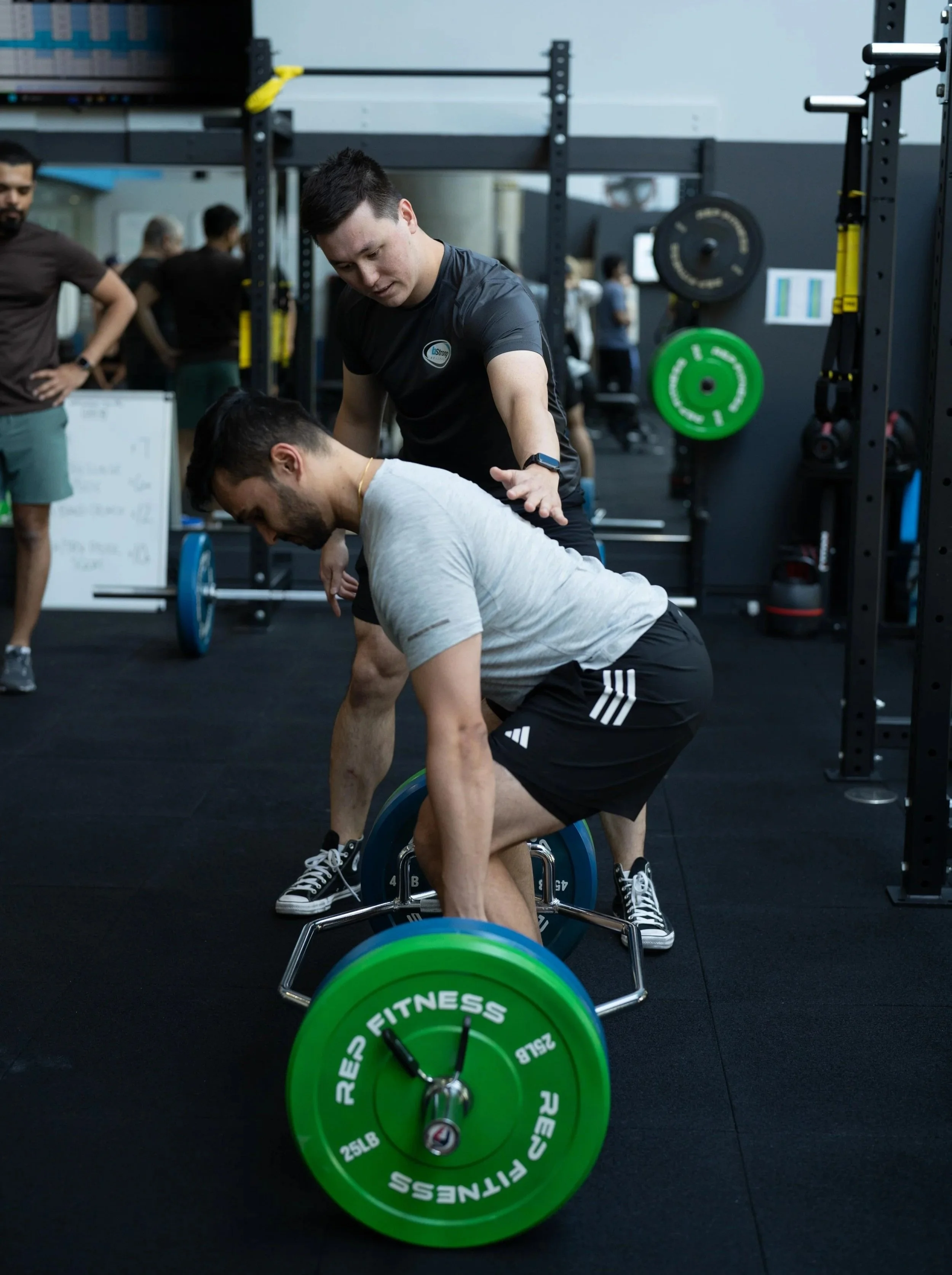
Groups stay small - 2-6 people - which means your coach can actually watch your form and tell you when your lower back is compensating or your shoulders are rounding. That specific feedback is what changes the movement patterns that sitting created.
Most members in this situation say the same thing after 6-8 weeks: their back feels better, their posture has improved, and they have more energy in the afternoons. The functional improvements come faster than most people expect.
For more on what the first 12 weeks looks like, read our beginner strength training guide.
How this usually starts at bStrong
The first step is a consultation call. We'll talk through your work setup, how your body feels during the day, whether mornings or evenings fit your schedule better, and what feels realistic right now.
From there, most people start with our $99 three-week trial. In your first few workouts, your coach helps you learn the main movement patterns, find safe starting weights, and build consistency without guesswork. Your workout and target weights are up on the screen when you walk in, and your coach helps you adjust from there.
Frequently asked questions
How often should desk workers strength train?
Two to three times per week is enough for meaningful results. Consistency over months matters more than frequency within any given week. Two sessions per week done consistently for six months produces better results than five sessions per week done for three weeks and then stopping.
Will strength training help my back pain from sitting?
For most desk workers, yes. The most common cause of back pain from prolonged sitting is weak glutes and tight hip flexors combined with a weak posterior chain. Strength training that includes deadlifts, hip hinges, and glute work directly addresses these causes. Most people see meaningful improvement within 6-8 weeks of consistent training. If you have a diagnosed condition or injury, consult your doctor or physical therapist before starting.
Is strength training better than yoga or stretching for desk workers?
They serve different purposes. Stretching and yoga provide temporary relief and improve flexibility. Strength training builds the muscular capacity to hold good posture and absorb load over time. For desk workers, the underlying problem is weakness - not just tightness - which means strengthening is more durable than stretching alone. The best approach combines both: strength training as the foundation, mobility work as a complement.
Do I need to be fit before starting strength training?
No. Most members start as beginners or after years away from the gym. Starting with appropriate loads, learning movement patterns gradually, and building over weeks and months is the right approach regardless of starting point. You don't need to earn your way into a program.
How long before I notice a difference?
Most desk workers notice improved energy and reduced afternoon fatigue within the first 3-4 weeks. Reductions in back pain and improved posture typically become noticeable between weeks 4-8. Visible changes in body composition take longer - usually 3-6 months. The functional improvements come faster than most people expect.
If this sounds like your day - the back that tightens up by afternoon, the energy that drops after lunch, the posture that's gotten worse every year - strength training is the most direct fix available.
Not a standing desk. Not a posture corrector. The actual muscles that are supposed to hold you up, built back up through consistent training.
Our 3-week trial is a straightforward place to start. Consultation call, Intro Ramp-Up session, 6 coached small group personal training workouts, and an InBody scan - all for $99 at our Bellevue and Redmond locations. No long-term commitment.